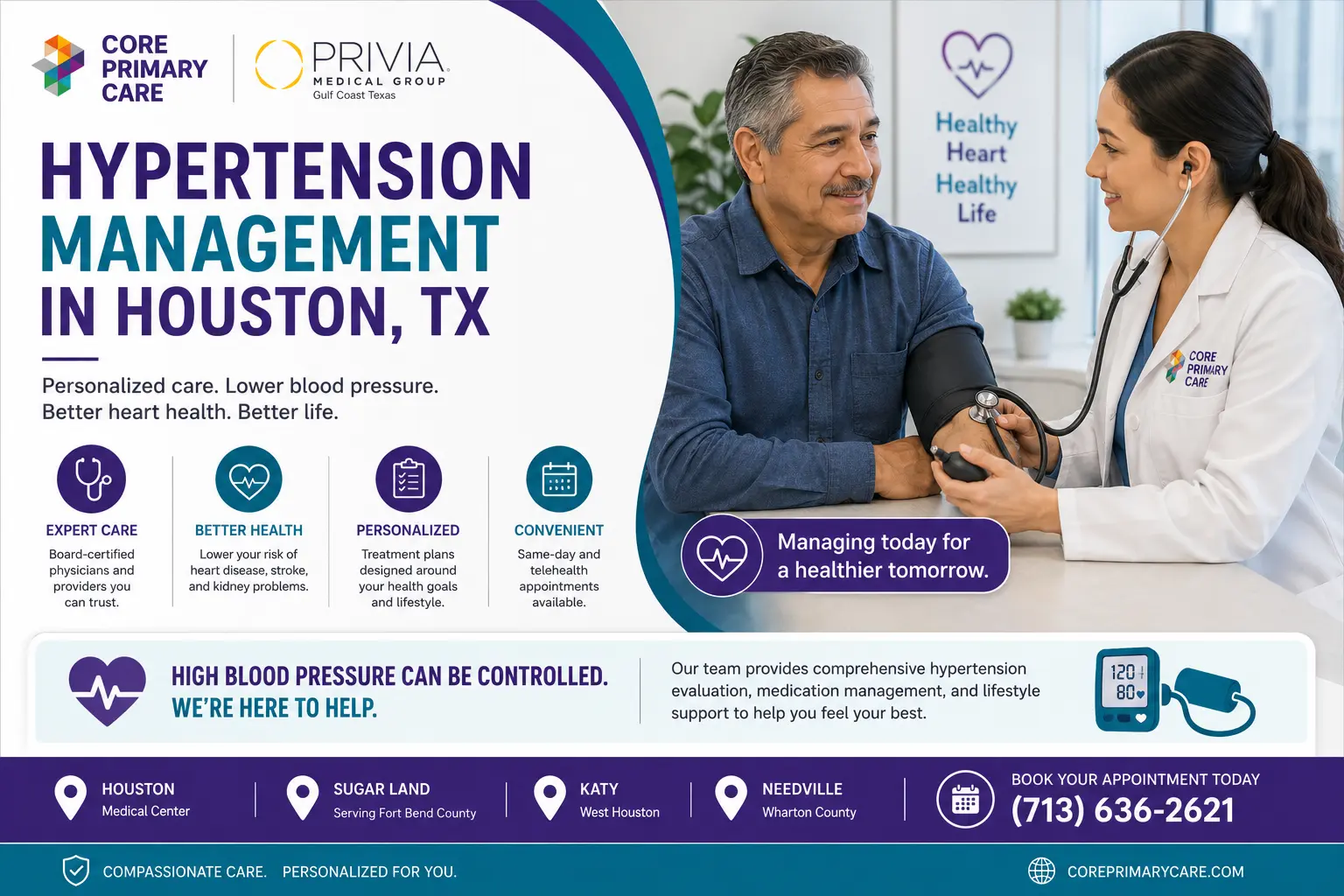
Core Primary Care offers hypertension treatment and high blood pressure management at four Houston-area locations — Houston Medical Center, Sugar Land, Katy, and Needville, TX. Our board-certified physicians and nurse practitioners diagnose hypertension, prescribe and manage medication, and develop personalised lifestyle treatment plans to lower your blood pressure and reduce your risk of heart disease and stroke. Same-day and telehealth appointments available. Call (713) 636-2621 or book an appointment online today.
High blood pressure is one of the most common health conditions in the United States — and one of the most underdiagnosed. Hypertension often produces no noticeable symptoms for years while silently damaging arteries, the heart muscle, the kidneys, and blood vessels throughout the body. By the time serious health problems appear, significant cardiovascular damage may already have occurred.
At Core Primary Care in Houston, TX, our clinical team provides evidence-based hypertension treatment within your existing primary care relationship. Your blood pressure levels are managed alongside your other health conditions — diabetes, heart disease, kidney disease — by the same physician who knows your complete medical history. We serve patients across Houston, Sugar Land, Katy, and Needville with personalised, accessible hypertension management that fits around your life. Call us or book online today.
Hypertension — commonly called high blood pressure — is a health condition in which the force of blood pushing against your artery walls remains persistently too high. Over time, this sustained pressure causes narrowing and thickening of the arteries, impairs blood flow, and forces the heart muscle to work harder with every beat. Without treatment, hypertension is a primary driver of heart disease, heart failure, stroke, and kidney disease.
Blood pressure is measured using a cuff (sphygmomanometer) placed around the upper arm. The reading records two numbers — systolic pressure (when the heart beats) and diastolic pressure (when the heart rests between beats) — expressed in millimetres of mercury (mmHg):
| Blood Pressure Category | Systolic / Diastolic Reading |
| Normal blood pressure | Less than 120 / less than 80 mmHg |
| Elevated — considered elevated but not yet hypertension | 120–129 / less than 80 mmHg |
| Stage 1 Hypertension | 130–139 / 80–89 mmHg |
| Stage 2 Hypertension | 140 or higher / 90 or higher mmHg |
| Hypertensive Crisis — seek emergency care | Higher than 180 / higher than 120 mmHg |
The lack of symptoms is what makes hypertension particularly dangerous. Most patients feel entirely well while blood pressure silently damages their heart and vascular system. Regular blood pressure measurement is the only reliable way to know your blood pressure levels — and early hypertension management is the most effective way to reduce your risk of life-threatening complications.
The cause of high blood pressure varies depending on the type of hypertension present. There are two distinct forms:
Primary (essential) hypertension is the most common form, affecting around 90–95% of people diagnosed with high blood pressure. It develops gradually over many years and has no single identifiable underlying health cause. Contributing risk factors include:
Secondary hypertension is caused by an identifiable underlying health condition. It typically produces higher blood pressure levels than primary hypertension and appears more suddenly. Common causes of secondary hypertension include:
Distinguishing primary from secondary hypertension determines the right treatment approach. Core Primary Care physicians complete a full diagnostic evaluation at your first visit — including blood tests, urinalysis, and cardiac assessment — to identify the underlying health cause before prescribing any therapy or medicine.
Hypertension is often called the silent killer because it produces no signs or symptoms in the vast majority of patients — even when blood pressure levels are dangerously high. When symptoms do occur, they are often nonspecific and easy to dismiss:
The absence of noticeable symptoms does not mean hypertension is not causing harm. The only accurate way to know your blood pressure is to measure it regularly with a calibrated cuff and stethoscope or a validated home monitor. Annual blood pressure measurement is part of every Core Primary Care physical examination — and same-day hypertension check appointments are available at all four locations.
Diagnosing hypertension requires more than a single blood pressure reading. Blood pressure fluctuates naturally throughout the day — it rises with activity, stress, and caffeine, and falls during rest. Core Primary Care physicians use multiple readings across at least two separate visits before confirming a hypertension diagnosis, following American Heart Association guidelines.
A comprehensive hypertension diagnostic evaluation at Core Primary Care includes:
For patients with suspected secondary hypertension or high blood pressure that does not respond to initial treatment, Core Primary Care physicians coordinate referrals to cardiology and nephrology specialists within the Privia Medical Group network in Houston. Your primary care physician stays involved throughout, managing your overall care and communicating with any specialist involved.
Core Primary Care’s approach to hypertension treatment combines evidence-based medicine with individualised lifestyle planning. Every treatment plan is built around your specific blood pressure levels, health history, other medical conditions, risk factors, and personal goals — not a generic protocol.
Lifestyle changes are the foundation of hypertension management and the first line of treatment for elevated and Stage 1 hypertension. For many patients, the right lifestyle modifications alone are sufficient to lower blood pressure to a healthy level without medication. Core Primary Care physicians counsel patients on:
When lifestyle changes alone are not sufficient to lower your blood pressure to a safe level — or when blood pressure is high enough to require immediate treatment regardless of lifestyle — Core Primary Care physicians prescribe and manage antihypertensive medications. The type of medicine selected depends on the stage of hypertension, the presence of comorbid conditions (diabetes, kidney disease, heart failure), and how your body responds. Common medication classes include:
Medication management at Core Primary Care includes regular follow-up visits to monitor blood pressure levels, assess medication side effects, check kidney function and electrolytes, and adjust dosages. If a medicine is not producing results within four to six weeks or causes side effects, your physician adjusts the treatment plan. The goal is to find the lowest effective dose that manages your blood pressure safely without compromising quality of life.
Managing your blood pressure is an ongoing process, not a one-visit fix. Core Primary Care’s hypertension management programme includes:
Without treatment, sustained high blood pressure causes progressive, cumulative damage to the circulatory system. The longer blood pressure remains elevated, the greater the buildup of cardiovascular risk. Major complications of untreated hypertension include:
The serious health consequences of untreated hypertension are preventable. Patients who manage their blood pressure to below 130/80 mmHg through a combination of lifestyle changes and medication reduce their risk of stroke by up to 40% and their risk of heart attack by up to 25%.
For patients with elevated blood pressure readings or significant risk factors, early intervention through lifestyle changes can prevent progression to a clinical hypertension diagnosis. For those already managing hypertension, the same preventive strategies reduce the risk of cardiovascular complications over time.
Key preventive measures discussed at every Core Primary Care annual physical and chronic disease management visit:
| What Core Primary Care Offers | Why It Matters for Hypertension |
| Integrated care | Your high blood pressure is managed alongside diabetes, kidney disease, and other conditions — by the same physician who knows your full medical history. |
| Same-day appointments | High blood pressure readings above 140/90 should not wait weeks for an appointment. Same-day slots are available at all four locations. |
| Medication management | Our physicians prescribe, monitor, and adjust antihypertensive medications — with telehealth follow-up between office visits. |
| Cardiology coordination | When heart and vascular complications require specialist input, your physician coordinates with Privia-affiliated cardiologists in Houston. |
| Telehealth blood pressure check-ins | Between in-person visits, telehealth appointments allow medication reviews and symptom checks without travelling to the clinic. |
| Insurance accepted | Core Primary Care accepts most major insurance plans and Medicare for hypertension treatment and chronic disease management. |
| Four Houston-area locations | Houston Medical Center, Sugar Land, Katy, and Needville — hypertension treatment near where you live and work. |
High blood pressure (hypertension) is defined as a blood pressure reading of 130/80 mmHg or higher on two or more separate occasions. A reading of 120–129 systolic with a diastolic below 80 is classified as elevated — not yet hypertension, but a clear signal that lifestyle changes and regular monitoring are needed. Normal blood pressure is below 120/80 mmHg. Any reading above 180/120 mmHg is a hypertensive crisis requiring immediate emergency evaluation.
Most people with hypertension experience no signs or symptoms — this is why it is often called the silent killer. In rare cases, very high blood pressure causes headaches, blurred vision, or nosebleeds, but these are not reliable indicators and often appear only when blood pressure is severely elevated. The only way to know your blood pressure levels is to have them measured with a calibrated cuff and stethoscope at a clinical appointment or with a validated home blood pressure monitor.
Most patients with hypertension are effectively managed by a primary care physician without needing a cardiologist. Core Primary Care handles the full spectrum of hypertension management — diagnosis, lifestyle counselling, prescribing and adjusting medication, and long-term monitoring. If your blood pressure does not respond to two or more medications, or if investigations reveal hypertension-related heart and vascular complications, your physician will coordinate a referral to a cardiologist through the Privia Medical Group specialist network in Houston.
For elevated and Stage 1 hypertension, lifestyle modifications can lower blood pressure to normal levels without medication. The most effective strategies are: reducing sodium intake to below 1,500–2,300mg per day, engaging in at least 150 minutes of moderate aerobic exercise per week, achieving and maintaining a healthy body weight, limiting alcohol intake, and following a diet rich in potassium and low in saturated fat. These lifestyle changes can reduce systolic pressure by 5–15 mmHg in many patients. Your Core Primary Care physician reviews all lifestyle treatment options at your first hypertension appointment and monitors your progress at follow-up visits.
Yes. Hypertension diagnosis, treatment, and ongoing blood pressure management are covered by most major insurance plans and by Medicare Part B as part of chronic disease management. All four Core Primary Care locations accept Medicare and most major insurance plans. Contact our office before your appointment and our team will verify your coverage for hypertension treatment and any associated diagnostic testing.
Same-day and next-day appointments are available at all four Core Primary Care locations in Houston, Sugar Land, Katy, and Needville. Book online through the Privia patient portal or call (713) 636-2621. If your blood pressure is above 180/120 mmHg, do not schedule an appointment online — this is a hypertensive crisis requiring emergency evaluation. Go to the nearest emergency room or call 911 immediately.
The most commonly prescribed antihypertensive medications are ACE inhibitors, angiotensin receptor blockers (ARBs), calcium channel blockers, thiazide diuretics, and beta-blockers. The right medicine for your hypertension depends on the stage of your blood pressure, any co-existing conditions (diabetes, kidney disease, heart disease), and how your body responds. Core Primary Care physicians prescribe, monitor, and adjust hypertension medications at regular follow-up appointments — with telehealth check-ins available between visits.
Primary hypertension is a chronic health condition that requires ongoing management rather than a cure. However, it is highly manageable. Many patients achieve blood pressure well within the normal range through a combination of lifestyle changes and medication — reducing their risk of cardiovascular complications to near that of someone who never had hypertension. Secondary hypertension caused by an identifiable underlying condition (such as a correctable kidney disorder or an adrenal tumour) can sometimes be resolved by treating the underlying cause, with blood pressure returning to normal after treatment.
Core Primary Care offers hypertension treatment and blood pressure management at all four greater Houston area locations:
| Houston Medical Center | Sugar Land, TX | Katy, TX | Needville, TX |
| In-person + telehealth | In-person + telehealth | In-person + telehealth | In-person + telehealth |
High blood pressure rarely gives warning signs — but it never stops causing damage. If you have not had your blood pressure checked recently, or if a previous reading was above normal, Core Primary Care’s hypertension treatment team is ready to help. We offer same-day appointments, Saturday hours, and telehealth options across four Houston-area locations.
Call (713) 636-2621 or book an appointment online today to schedule a confidential hypertension consultation at Core Primary Care in Houston, Sugar Land, Katy, or Needville, TX.
| Call Us(713) 636-2621 | Book Appointment Onlinecoreprimarycare.com | Telehealth Virtual Visit available same-day |